Congratulations to Xiang Zhang on Publishing a Research Article in Chinese Journal of Catalysis
Efficient nitrate electroreduction to ammonia via synergistic cascade catalysis at Cu/Fe2O3 hetero-interfaces
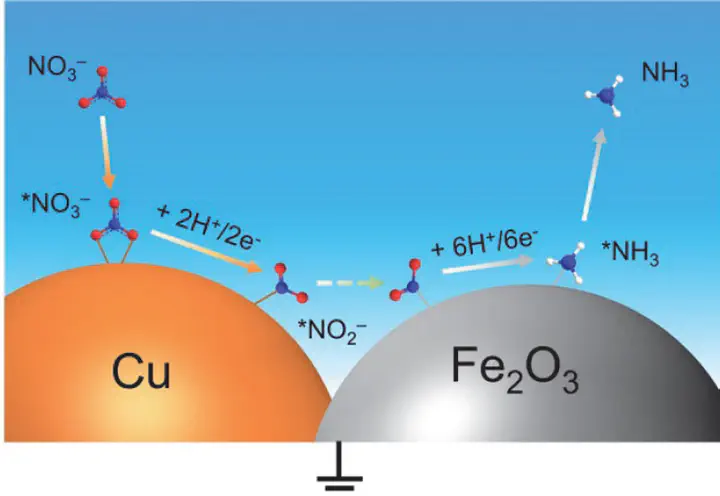
Electrochemical nitrate (NO3−) reduction offers a promising route for ammonia (NH3) synthesis from industrial wastewater using renewable energy. However, achieving selective and active NO3− to NH3 conversion at low potentials remains challenging due to complex multi-electron transfer processes and competing reactions. Herein, we tackle this challenge by developing a cascade catalysis approach using synergistic active sites at Cu-Fe2O3 interfaces, significantly reducing the NO3− to NH3 at a low onset potential to about +0.4 VRHE. Specifically, Cu optimizes *NO3 adsorption, facilitating NO3− to nitrite (NO2−) conversion, while adjacent Fe species in Fe2O3 promote the subsequent NO2− reduction to NH3 with favorable *NO2 adsorption. Electrochemical operating experiments, in situ Raman spectroscopy, and in situ infrared spectroscopy consolidate this improved onset potential and reduction kinetics via cascade catalysis. An NH3 partial current density of ~423 mA cm−2 and an NH3 Faradaic efficiency (FENH3) of 99.4% were achieved at −0.6 VRHE, with a maximum NH3 production rate of 2.71 mmol h−1 cm−2 at −0.8 VRHE. Remarkably, the half-cell energy efficiency exceeded 35% at −0.27 VRHE (80% iR corrected), maintaining an FENH3 above 90% across a wide range of NO3− concentrations (0.05−1 mol L−1). Using 15N isotopic tracing, we confirmed NO3− as the sole nitrogen source and attained a 98% NO3− removal efficiency. The catalyst exhibit stability over 106-h of continuous operation without noticeable degradation. This work highlights distinctive active sites in Cu-Fe2O3 for promoting the cascade NO3− to NO2− and NO2− to NH3 electrolysis at industrial relevant current densities.
The related research findings were published in CJC under the title "Efficient nitrate electroreduction to ammonia via synergistic cascade catalysis at Cu/Fe2O3 hetero-interfaces".
Article link: https://www.sciencedirect.com/science/article/pii/S1872206724601944